
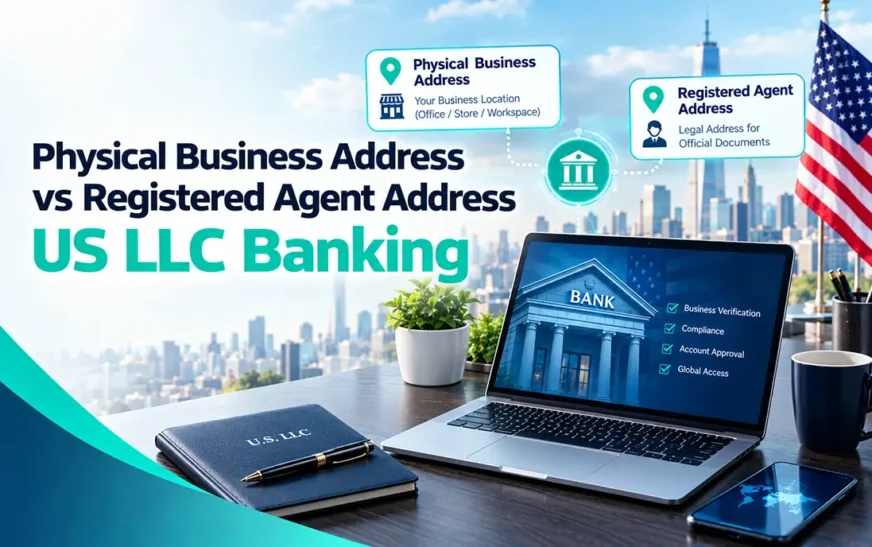
Physical business address vs registered agent address us llc banking is an important topic for non-US entrepreneurs who want to open a US business bank account. Although both addresses may be associated with your LLC, they serve different purposes, and using the wrong address can lead to verification questions, application delays, or rejection.
If you formed a US LLC through a registered agent, you may wonder whether you can use that same address to apply for an account with Mercury, Relay, or another business banking provider. The answer depends on the bank’s current address policy and how your business actually operates.
In this guide, we explain physical business address vs registered agent address us llc banking, including the differences between a physical business address, registered agent address, virtual office, residential address, and commercial mail receiving agency (CMRA).
You will also learn how to select an appropriate address, which documents may be requested, and which mistakes to avoid before applying.
What Is Physical Business Address vs Registered Agent Address US LLC Banking?
Understanding physical business address vs registered agent address us llc banking starts with knowing what each address is designed to do.
A physical business address generally identifies an eligible location associated with the company’s actual operations. Depending on the bank’s rules, this could be an office, an eligible home office, or another verifiable location where the business conducts its activities.
A registered agent address is the address designated to receive legal notices, official correspondence, and service of process on behalf of the LLC. It is often the registered agent’s office, not the location where the company itself operates.
When comparing physical business address vs registered agent address us llc banking, remember that a legal address and an operating address may serve different purposes.
| Address type | Main purpose | Banking considerations |
|---|---|---|
| Physical business address | Identifies an eligible business operating location | Must meet the provider’s address and verification rules |
| Registered agent address | Receives legal notices and service of process | May be accepted for legal purposes but not necessarily as an operating address |
| Residential address | Identifies where an individual lives | Acceptance depends on the address field and provider policy |
| Virtual office address | May provide business address, mail handling, or workspace services | Not automatically accepted as a physical operating address |
| CMRA or mail center | Receives and forwards mail | May be restricted for physical-address verification |
| PO Box | Receives postal mail | Generally not a substitute for a required physical address |
The key to physical business address vs registered agent address us llc banking is to match the address to the bank’s specific requirements.
Important: An address accepted when forming your LLC is not automatically acceptable for opening a business bank account.
Why Does Your US LLC Need the Right Address for Banking?
Banks and financial technology providers may request address information to verify your company, understand its operations, meet compliance obligations, and determine whether it qualifies for their services.
Physical business address vs registered agent address us llc banking can affect how a provider verifies your company information. If you enter a registered agent address in a field requiring a physical operating address, the provider may request clarification or supporting documents.
Common address-related mistakes include:
- Using a registered agent address as the physical operating address without checking the rules.
- Entering a virtual office or mail forwarding address that the provider does not accept.
- Providing an address that cannot be verified using the documents submitted.
- Using inconsistent addresses across the application and company records.
- Claiming to operate from an office where the business does not actually conduct activities.
- Confusing the company’s address with an owner’s residential address.
- Paying for an address service before confirming whether the provider accepts that address type.
Before applying, research physical business address vs registered agent address us llc banking to avoid using an address for a purpose it does not support.
What Is a Registered Agent Address for a Bank Account?
A registered agent is a person or business appointed to receive legal and official notices for your LLC. Many non-US founders use registered agent services when forming a US company.
However, the registered agent’s office usually belongs to the agent. It does not automatically become the actual operating location of your business.
When researching physical business address vs registered agent address us llc banking, identify which address the application is asking for:
- Legal business address: The address recorded for legal or company purposes.
- Physical operating address: The location where the company actually conducts business, as defined by the provider.
- Mailing address: The address where you want to receive correspondence.
- Residential address: Your actual home address, where requested for an owner or controlling person.
A provider may ask for more than one of these addresses. They should not be treated as interchangeable.
A registered agent agreement may prove that you use the agent’s service, but it does not necessarily prove that your business operates at that address.
Mercury Bank Address Requirements for Non-US LLC Owners
Mercury offers business banking services to eligible US companies, including certain businesses owned by non-US residents. However, applicants must still meet Mercury’s eligibility and address requirements.
According to Mercury’s published company address guidance, the company’s physical address must satisfy its requirements. Mercury distinguishes the legal address from the physical location where the business operates, and its rules restrict using certain address types—including registered agent addresses, PO Boxes, virtual addresses, and commercial mail receiving agencies—as the company’s physical address.
A verifiable residential or international address may be acceptable in applicable circumstances, depending on the address field and Mercury’s current requirements.
Read Mercury’s official guidance before applying:
Can You Use a Registered Agent Address for a Mercury Account?
You should not use a registered agent address as Mercury’s physical company address when it does not meet Mercury’s published requirements.
For Mercury applicants, physical business address vs registered agent address us llc banking is especially important because the company has specific physical-address requirements.
Instead, identify the genuine location associated with your business and check whether Mercury accepts that address type for the relevant field. If you work remotely from outside the United States, review Mercury’s instructions for international addresses and provide accurate information.
Do not rent an address simply because you believe it will guarantee approval. The address must be genuine, verifiable, and appropriate for the field in which you enter it.
If your application has already been declined, read our guide: Mercury Bank Application Rejected? What to Do Next.
You can also read our guide on how to open a Mercury bank account as a non-resident.
Relay Financial Address Requirements: Legal Address vs Operating Address
Relay has its own address requirements, which may differ from Mercury’s policy.
Relay’s published guidance explains that a registered agent address may be used as the legal business address in certain circumstances, but it cannot automatically replace the operating address when Relay requests a separate operating location. Relay also distinguishes an operating address from an owner’s personal residential address.
Review Relay’s official resources:
- Relay: Using a Registered Agent Address and Operating Address
- Relay: Accepted Address Verification Documents
Can a Registered Agent Address Work for Relay?
It may be accepted for the legal address field under Relay’s rules, but that does not mean it qualifies as the operating address.
For Relay applicants, physical business address vs registered agent address us llc banking requires checking the rules for both the legal business address and the operating address.
Read the wording of each application field carefully. If Relay asks where your company operates, provide the genuine operating location and the documents Relay requests to verify it.
Always verify physical business address vs registered agent address us llc banking against Relay’s latest official guidance before submitting your information.
For more information, read our Relay Financial account guide for non-US residents.
Commercial Mail Receiving Agency vs Physical Address for US Bank Accounts
A commercial mail receiving agency, commonly called a CMRA, receives mail for customers and may forward it to another address. Mailbox rental businesses and some mail forwarding services fall into this category.
A CMRA address can be useful for correspondence, but it does not automatically qualify as a physical operating address for every bank.
Physical business address vs registered agent address us llc banking also helps explain why a mail forwarding service may not qualify as a physical operating location.
Before using a mail service, check the following:
- Whether the provider accepts CMRA addresses.
- Whether the address is being entered as a legal, mailing, or operating address.
- Which documents are required to verify the address.
- Whether the service accurately represents how your business operates.
Do not assume that receiving official mail at an address makes it suitable for bank verification.
Is a Virtual Office Address Acceptable for a US Business Bank Account?
A virtual office may offer a business mailing address, mail handling, meeting rooms, or occasional workspace. The services offered can vary significantly.
The term “virtual office” does not automatically establish whether a particular address will be accepted by a bank. Some providers restrict virtual addresses for physical operating-address verification, while others may assess the arrangement according to their own policies.
A careful review of physical business address vs registered agent address us llc banking can help you decide which address questions to ask your provider.
Before paying for a virtual office, ask the service provider what it actually includes and check the bank’s official requirements. Do not describe a virtual office as your actual operating location unless that description is accurate and meets the provider’s rules.
What Is the Best Physical Business Address for a Non-Resident US LLC?
The best address depends on where your business genuinely operates and which address types your chosen banking provider accepts.
1. You Operate Your Business From Outside the United States
Your actual overseas business or residential address may be relevant, depending on the bank’s rules and the field being completed. Check the provider’s requirements for international founders before applying.
2. You Work From a Genuine US Office
If your company actually operates from a US office and you can provide acceptable evidence, that location may be appropriate for the physical operating-address field.
3. You Use a Registered Agent Only for LLC Formation
Use the registered agent address for the purposes it is intended and permitted to serve. Do not assume it qualifies as your company’s operating address.
4. You Use a Mail Forwarding Service
Check whether the bank accepts the service for mailing purposes and whether it separately requires a physical operating address.
5. You Work Remotely
Describe your real operating arrangement accurately. Do not invent an office, claim to occupy a location you do not use, or submit documents that misrepresent your business.
Physical business address vs registered agent address us llc banking ultimately comes down to choosing an address that matches your real business circumstances and the provider’s rules.
For background on choosing a state for your LLC, read our guide to Wyoming vs Delaware LLCs for non-residents.
Documents You May Need to Verify Your Business Address
The exact documents depend on the provider, your address type, and your circumstances. A bank may request additional evidence during its review.
Potentially relevant documents include:
- LLC formation documents or company records.
- A lease or other documentation for a genuine business location.
- A utility bill or another accepted proof of address, where applicable.
- Official correspondence showing the address, if accepted by the provider.
- Additional documentation requested by the bank.
Not every document is accepted by every provider. A registered agent agreement, for example, does not necessarily prove that your business operates at the agent’s address.
Use the provider’s current accepted-document list rather than relying on a generic checklist. For Relay, see its official address verification document requirements.
How to Avoid Address-Related Banking Application Problems
Use this checklist before submitting your application:
- Confirm the provider’s eligibility requirements for non-US founders.
- Identify which fields require a legal address, operating address, mailing address, or residential address.
- Enter genuine and accurate address information.
- Check that your documents support the address and address type you provide.
- Review the provider’s current restrictions on registered agents, virtual offices, CMRAs, and PO Boxes.
- Make sure your application does not contradict your company records or other submitted information.
- Respond promptly and accurately if the provider requests clarification.
- Save copies of the documents you submit.
Physical business address vs registered agent address us llc banking should be reviewed before you apply, not after a provider asks you to correct an address mismatch.
Correcting an address mismatch may help resolve a verification issue, but no address or document guarantees account approval.
Frequently Asked Questions
Can I use my registered agent address to open a US LLC bank account?
It depends on the provider and the address field. A registered agent address may be allowed for legal business purposes in some cases, but it may not qualify as a physical operating address.
Is a registered agent address the same as a physical business address?
No. A registered agent address is generally used to receive legal notices. A physical business address usually refers to a qualifying location associated with the company’s actual operations or another location accepted by the provider.
Does Mercury accept registered agent addresses?
Mercury’s published requirements restrict registered agent addresses for the company’s physical address. Review Mercury’s current company address requirements and determine which address is appropriate for each field.
Does Relay accept registered agent addresses?
Relay may allow a registered agent address for the legal business address under its published rules, but a separate operating address may still be required. Review Relay’s registered agent and operating address guidance before applying.
Can I use a virtual office address for a US business bank account?
Not automatically. Some providers restrict virtual offices for physical operating-address verification. Confirm the provider’s current policy and describe your business location accurately.
Is a CMRA address the same as a virtual office?
No. A CMRA primarily handles mail for customers, while a virtual office may provide additional services such as workspace or meeting facilities. The services and banking eligibility of each address must be assessed separately.
What should I do if my bank rejects my business address?
Read the rejection notice, review the provider’s address policy, and identify whether the problem concerns your legal, operating, mailing, or residential address. Contact the provider for clarification and submit accurate supporting documents if requested.
You can also read our guide on what to do when a Mercury application is rejected.
Final Thoughts
Understanding physical business address vs registered agent address us llc banking can help non-US founders avoid preventable application mistakes.
A registered agent address serves an important legal purpose, but it does not automatically qualify as a physical operating address. Mercury and Relay have their own requirements, so check the latest official guidance before choosing an address or submitting an application.
The most reliable approach is to use accurate information, provide the right documents, and make sure every address matches the purpose of the field in which it is entered.
If you are unsure whether an address qualifies, ask the banking provider before applying. This is safer than paying for an address service based on assumptions or submitting information that does not accurately reflect your business.
Disclaimer: This article is for informational purposes only and is not legal, tax, or financial advice. Banking eligibility, address policies, and documentation requirements can change. Always verify current requirements directly with the relevant provider.