
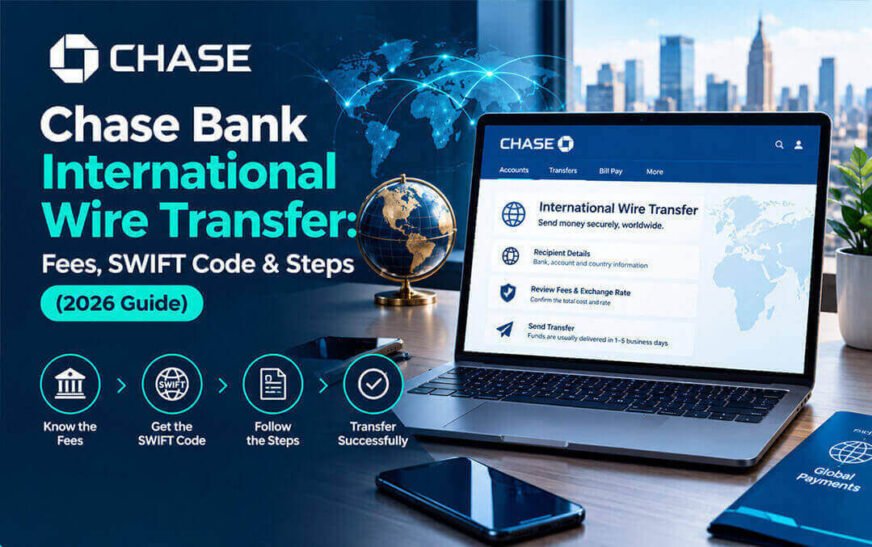
Quick Answer: A Chase bank international wire transfer costs $40 to send online in US dollars, $50 with a banker, and $15 to receive on Business Complete Checking (per Chase’s fee schedule effective 06/14/2026). Senders use SWIFT CHASUS33 plus your account number. Chase doesn’t use IBANs. Terms vary by account.
Introduction
If you run a US LLC from outside the United States, a Chase bank international wire transfer is one of the most common ways to move money in or out. The fee is only part of the cost, though. Chase also sets its own exchange rate, intermediary banks can deduct charges, and the account type changes what you pay.
This guide uses Chase’s own business fee schedule (effective 06/14/2026) for every fee figure. It also covers what a non-US founder should know before relying on Chase at all. Banking policies change, so verify current terms on chase.com before you send or receive anything.
Step-by-Step Breakdown: Chase International Wire Transfer Fees, Details and Process
Chase International Wire Transfer Fees (Business Accounts)
These figures come from Chase’s Business Deposit Account Agreement fee schedule, effective 06/14/2026:
| Wire Type | Business Complete Checking | Performance Business Checking | Platinum Business Checking |
|---|---|---|---|
| Incoming international wire | $15 ($0 if sent via a Chase banker, chase.com or Chase Mobile) | $0 | $0 |
| Outgoing international, USD, online | $40 | $40 (outgoing waivers apply to domestic wires only) | $40 (first 4 most expensive outgoing wires free per statement period) |
| Outgoing international, foreign currency, online | $5, or $0 if $5,000 USD or more | $5, or $0 if $5,000 USD or more | $5, or $0 if $5,000 USD or more |
| Outgoing international, with a banker | $50 | $50 | $50 |
Chase also states that the “no fee” benefit does not cover the spread built into its foreign exchange rate, and that other banks in the chain may deduct their own fees. A $0 wire fee therefore does not mean a free transfer. Personal accounts have a different schedule, so don’t reuse these numbers for a personal Chase account.
Chase bank international wire transfer calculator (manual method): Add the Chase fee, the FX spread (compare Chase’s quoted rate with the mid-market rate), and any intermediary deductions. Then compare the net amount your recipient receives, not the headline fee.
Chase SWIFT Code and Wire Details for Receiving Money
To receive an international wire into a Chase account, your sender typically needs:
- Beneficiary name: exactly as it appears on the Chase account
- Beneficiary address: the address on file
- Account number: your Chase account number, not the routing number
- SWIFT/BIC code: CHASUS33 (8-character head-office code)
- Bank name and address: JPMorgan Chase Bank, N.A., 383 Madison Avenue, New York, NY 10179 (this is the SWIFT registry address listed by Wise and other directories)
Chase bank IBAN and routing number: US accounts don’t use IBANs. The domestic wire routing number often cited is 021000021, but this is for domestic wires. International senders use SWIFT. Because wire details can differ by account, pull your exact wire instructions from chase.com or the Chase Mobile app instead of copying numbers from a blog, including this one.
How to Send an International Wire from Chase
- Log in to chase.com or Chase Mobile and open the wire transfer section. Enrollment may be required first.
- Add the recipient: full name, address, bank name, SWIFT/BIC, and account number or IBAN.
- Choose US dollars or foreign currency. Chase displays its exchange rate before you confirm.
- Review the fee and confirm the recipient’s details.
- Submit and track the wire. International wires generally take one to five business days.
Limits and Timing
Chase doesn’t publish one universal international wire limit for business accounts. Your limit appears in the app or online when you start a wire. Third-party sites quote figures such as $25,000 per day online for personal accounts, but those are not official for your account. To raise a limit or wire larger amounts, contact Chase before the transfer date.
Common Rejection Reasons and Practical Fixes
There are two separate failure points: opening the account and the wire itself.
Can a Non-US Resident Open a Chase Business Account?
Chase’s LLC checklist says all members of a member-managed LLC (or all managers of a manager-managed one) must be present at account opening, and it collects each 10%+ owner’s tax ID (SSN, ITIN or foreign TIN) and country of citizenship. Chase states that accounts are subject to approval. Secondary sources report that non-residents generally open accounts in person at a US branch and may need a verifiable US address. I could not confirm a dedicated remote program for non-residents. Call a branch first and confirm.
Why Wires Fail or Get Delayed
| Problem | Likely Cause | Fix |
|---|---|---|
| Account opening stalls | EIN letter mismatch, or the address on formation documents differs from the application | Use the IRS CP575 or a 147C verification letter, and keep legal name and address identical across documents. See the CP575 vs 147C guide. |
| KYC/AML review | Unclear ownership, or a registered agent address used as the operating address | Prepare your Articles of Organization, operating agreement and ID. See virtual mailbox rules. |
| Incoming wire not credited | Name mismatch, wrong account number, or a compliance hold | Match the beneficiary name exactly and ask the sender for the SWIFT confirmation. |
| Less money than expected | Intermediary bank fees and the FX spread | Ask the sender to send in USD, or compare the net amount against other providers. |
| Wire returned | Sanctions screening, incorrect details, or the sender’s bank rejecting it | Contact the sending bank for the return reason code. |
Chase advises that recovering a wire after processing is difficult, so check recipient details before submitting.
How This Integrates with Your US Business Banking Setup
Forming an LLC doesn’t guarantee any bank will accept you. Chase is a traditional bank. Many non-US founders instead use fintech or multi-currency providers, so compare your options before committing:
- Chase is a brick-and-mortar option with predictable wire fees but, for most non-residents, an in-person account opening.
- If Chase isn’t workable, see the full US LLC bank account guide for non-US residents or the Mercury rejection fixes.
- For multi-currency payouts, compare Payoneer vs Wise Business.
- You’ll need an EIN first. Here’s how to get an EIN without an SSN, and the IRS EIN page is the official source. Verify the current process there.
Wires into a US LLC account can also have tax and reporting implications (for example, BOIR rules have changed recently, so check FinCEN’s current guidance). Review them with a qualified tax professional.
Frequently Asked Questions (FAQ)
Can Chase Bank receive international wire transfers?
Yes, eligible Chase accounts can receive them. Senders use SWIFT CHASUS33 and your account number. Incoming fees are $15 on Business Complete Checking and $0 on Performance and Platinum, per Chase’s fee schedule effective 06/14/2026.
How much does Chase charge for an international wire transfer?
For business accounts: $40 for an online USD wire, $50 with a banker, and $5 (or $0 at $5,000 USD or more) for an online foreign-currency wire. Chase also applies an exchange-rate spread on currency conversions.
Can I wire more than $25,000 per day with Chase?
Chase doesn’t publish one universal limit. Your limit depends on your account and is shown when you start the wire. Contact Chase ahead of time for larger transfers.
How long does a Chase international wire take?
Generally one to five business days, depending on the destination country, cutoff times, intermediary banks and compliance checks.
Final Verdict and Next Steps
Chase’s published wire fees are clear and the SWIFT code is simple, but your real cost depends on the FX spread, intermediary banks, and your account tier. The harder question for non-US founders is whether Chase will open an account for your LLC at all. Confirm eligibility with a branch before you travel.
Next steps:
- Confirm your EIN documents (CP575 or 147C) and formation papers.
- Call a Chase branch to confirm non-resident requirements.
- Pull your wire instructions from chase.com or Chase Mobile.
- Compare the net amount received against at least one alternative.
Disclaimer: Pay Global Hub is an independent educational publication covering cross-border fintech, business setup, and banking solutions. We are not a financial institution, bank, law firm, or certified tax consultancy. The information provided in this article is for informational and educational purposes only and should not be construed as legal, tax, or financial advice. Banking policies, legal requirements, and account acceptance criteria vary by individual case and institution. Always consult with a qualified legal or financial professional for specific advisory regarding your business entity.