
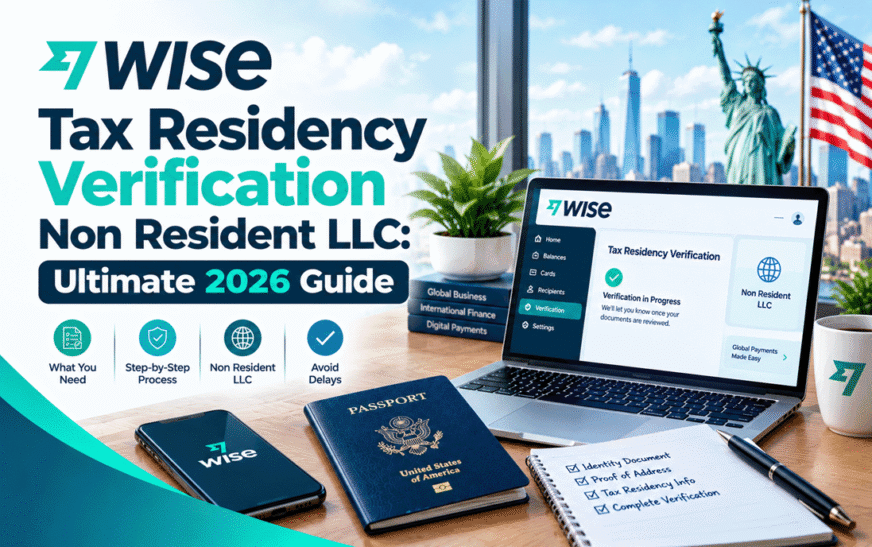
Opening a Wise Business account can help eligible international founders manage payments and cross-border transactions for their US LLCs. However, the verification process can become confusing when Wise requests a Tax Identification Number (TIN), proof of tax residency, a business address document, or additional information about the company.
These challenges are common questions for founders who operate a US LLC while living in Pakistan, the UK, the Philippines, or another country outside the United States.
The main issue is that company registration, personal tax residency, and business address verification are separate matters. Having a US LLC does not automatically make its owner a US tax resident. Similarly, an LLC’s Employer Identification Number (EIN) does not automatically replace the owner’s personal TIN.
This guide explains wise tax residency verification non resident llc requirements, how to respond to tax ID requests, why Wise may reject a business address, and what to do if your verification is delayed or declined.
The objective is to help you submit accurate information, understand the requirements, and resolve common documentation problems without misrepresenting your business.
What Is Wise Tax Residency Verification for Non-Resident LLC Owners?
Wise tax residency verification is the process of confirming where a customer is tax resident and collecting relevant tax identification details when required.
Wise explains that financial institutions collect tax residency self-certifications to comply with applicable tax transparency requirements, including the Common Reporting Standard (CRS), where relevant. Depending on the customer’s circumstances and the applicable rules, account information may be reported to relevant tax authorities.
For a non-US resident who owns a US LLC, Wise may request information about two different parties:
- The company: Legal business name, registration details, EIN, operating address, business activities, and ownership.
- The owner: Legal name, residential address, identification documents, tax residency, and personal TIN where applicable.
For example, a founder living in Pakistan may own a Wyoming LLC. The company is registered in the United States, but the founder’s personal tax residency may remain in Pakistan, depending on the applicable tax rules.
These details must be reported accurately. A difference between the LLC’s registration country and the owner’s tax residency is not automatically an error.
For the official explanation, read Wise’s tax details verification guide.
Does a US LLC Automatically Make You a US Tax Resident?
No. Owning a US LLC does not, by itself, make an individual a US tax resident.
Personal tax residency depends on applicable tax laws and an individual’s circumstances. Citizenship, immigration status, physical presence, company ownership, and tax residency are not interchangeable concepts.
For instance, an entrepreneur who lives in Pakistan and owns a US LLC may have personal tax residency in Pakistan while still having US tax obligations related to the business.
Likewise, a UK resident who owns a Delaware LLC does not automatically become a US tax resident merely because the company was formed in Delaware.
Keep these terms separate:
| Term | Meaning |
|---|---|
| LLC registration | The state where the company was legally formed |
| EIN | A federal tax identification number assigned to an eligible business or entity |
| Personal tax residency | The country or countries where a person is treated as tax resident under applicable laws |
| Personal TIN | A tax identification number used to identify a taxpayer |
| Registered address | The address recorded for the company’s official registration |
| Trading address | The physical location where the business actually operates |
Understanding these distinctions is essential for wise tax residency verification non resident llc cases. Do not select the United States as your personal tax-residency country solely because your LLC has a US registration or EIN.
If you have tax residency in multiple countries or an unusual cross-border situation, consult a qualified tax professional before submitting a declaration.
Which TIN Should a Non-Resident LLC Owner Provide?
One of the most common verification questions is whether Wise needs the LLC’s EIN, the owner’s SSN, an ITIN, or a tax number from the owner’s country of residence.
The answer depends on the specific field and the person or entity being verified.
EIN vs SSN vs ITIN vs Foreign TIN
| Identification number | Generally relates to | Important distinction |
|---|---|---|
| EIN | A business or other eligible entity | Commonly requested for US business verification |
| SSN | An eligible individual in the US system | Not automatically required of every foreign LLC owner |
| ITIN | An individual who needs a US tax identification number but is not eligible for an SSN, subject to IRS rules | Does not establish US tax residency by itself |
| Foreign TIN | A taxpayer identified under another country’s tax system | May be relevant to personal tax-residency declarations |
Wise’s US business verification guide explains that requirements vary by business type. It requests business information such as the EIN and distinguishes between US and non-US beneficial owners when describing identification requirements.
An EIN and a personal TIN serve different purposes. Do not assume that entering your LLC’s EIN will satisfy a request for your personal tax-residency information.
Should You Enter Your Home-Country TIN?
If Wise asks for the TIN associated with your country of tax residence, check the relevant country’s rules and provide the correct number when applicable.
For example, a Pakistani founder should review the tax identification information relevant to their circumstances. A UK resident should check the appropriate UK tax identification requirements.
Do not substitute your LLC’s EIN for your personal foreign TIN unless Wise specifically instructs you to provide that business identifier in the relevant field.
If your country does not issue a TIN for your circumstances, or you have a valid reason for not having one, follow the instructions in Wise’s tax self-certification form and explain the situation where permitted.
Never invent a tax number, enter another person’s identification number, or claim tax residency in a country where you are not tax resident.
What If Wise Asks for a US SSN?
First, check exactly which person and account type the request concerns.
Wise’s published US business verification guidance distinguishes between beneficial owners who reside in the United States or hold a US passport and non-US beneficial owners. It states that non-US beneficial owners may be asked for a copy of photo identification.
If an SSN request appears inconsistent with your situation:
- Review your account type and personal profile.
- Confirm whether the request relates to the business or an individual.
- Read the instructions shown in your Wise account.
- Contact Wise through its official support channel if the requirement does not appear applicable.
- Ask which alternative documents, if any, Wise can accept for your situation.
Do not enter a false number simply to continue the application.
For related information, read our guide on getting an EIN without an SSN.
How to Complete Wise Tax Residency Verification Step by Step
Following a structured process can help you organize your information before responding to a verification request.
Step 1: Confirm Your Actual Tax Residency
Identify the country or countries where you are treated as a tax resident under the applicable rules.
Your passport country, nationality, residential address, LLC registration state, and tax residency may all be different.
If you recently moved, maintain residences in multiple countries, or are unsure about your status, obtain professional advice before making a declaration.
Step 2: Identify the Correct Tax Identification Number
Read the question carefully and determine whether Wise requests:
- Your personal TIN
- Your LLC’s EIN
- Another business identification number
- An explanation of why a TIN is unavailable
Use the number that corresponds to the relevant person or entity. A business tax ID should not automatically be entered in a personal tax-residency field.
Step 3: Complete the Tax Self-Certification Accurately
Enter your legal name, country of tax residence, and requested identification details.
Check that the information is consistent with your personal profile and supporting records. If the form allows you to explain why you do not have a TIN, use that option only when it accurately reflects your situation.
Do not guess at answers simply to complete the form.
Step 4: Review Your Business and Personal Details
Check your LLC’s legal name, EIN, registered address, trading address, and ownership details against the relevant records.
Separately, check your personal name, date of birth, residential address, and identification documents.
Even a small spelling difference or an outdated address can trigger additional questions.
Step 5: Submit the Requested Documents
Upload the documents Wise specifically requests. Make sure they are complete, readable, and current according to the instructions provided.
Do not submit unrelated documents in the hope that they will replace the requested evidence.
Step 6: Monitor Your Account and Email
After submission, check for messages asking you to clarify information or provide additional documents.
Respond to the specific question raised, and keep a record of the documents submitted and any case reference provided by support.
These steps can make wise tax residency verification non resident llc easier to manage, but they cannot guarantee approval. Wise makes the final decision based on its applicable requirements and your circumstances.
Why Does Wise Reject a Non-Resident LLC’s Business Address?
Address verification is separate from tax residency verification. Your LLC can have valid registration documents and an EIN while still facing an address-related issue.
Wise distinguishes between a registered address and a trading address.
Registered Address vs Trading Address
Registered address: The address associated with the company’s official registration. This may be the address of a registered agent, attorney, or registration provider.
Trading address: The physical location where the business actually operates, such as an office, shop, studio, coworking space, or eligible home office.
According to Wise’s official US business verification guidance, the trading address must be a physical location. Wise says it cannot accept PO boxes, registration agencies, mail-forwarding services, or virtual addresses for this purpose, with limited exceptions such as military PO boxes.
A registered agent’s address may be appropriate for company registration without being acceptable as evidence of where the business operates.
Common Reasons for Address Rejection
| Possible issue | What to check | Recommended action |
|---|---|---|
| Registered agent address entered as trading address | Does the business actually operate there? | Provide the genuine trading address if required and eligible |
| Virtual office or mail-forwarding address | Is it only used to receive mail? | Do not describe it as a physical operating location |
| Outdated proof of address | Does the document meet Wise’s current date requirements? | Obtain a newer acceptable document |
| Address mismatch | Does the document show the address entered in Wise? | Correct genuine errors or provide appropriate evidence |
| Incomplete document | Are the relevant details and pages visible? | Upload a complete, readable copy |
| Unsupported document type | Is the document accepted for your verification request? | Choose an eligible document from Wise’s current requirements |
Which Documents May Help Verify a Trading Address?
Depending on your situation and Wise’s current requirements, examples of potentially acceptable evidence may include utility bills, signed lease agreements, bank statements, official business registration documents, tax documents, or certain insurance documents.
Acceptance depends on the document type, the information it shows, and the requirements that apply to your account.
Always review Wise’s business address verification guidance before submitting documents.
If you operate remotely from your home country, explain your actual arrangement and ask Wise what evidence it can accept for your business type. Do not create a false office address or describe a mail-receiving service as a place where you work.
How to Fix Wise Business Verification Problems
If your application is stuck or your documents have been rejected, use the troubleshooting table below.
| Problem | Possible reason | Recommended next step |
|---|---|---|
| Wise requests a TIN | Tax-residency self-certification is incomplete | Provide the correct TIN for the requested person and country, or explain its unavailability where permitted |
| EIN accepted but personal TIN requested | Business and personal tax details are separate | Check the field instructions and provide the appropriate information |
| SSN request appears inapplicable | The request may relate to a different ownership or account situation | Confirm the account details and ask Wise what evidence is acceptable |
| Trading address rejected | Address type or supporting proof may not meet the requirements | Check the physical address, document date, and address match |
| Business activity is unclear | Wise needs to understand the company’s operations | Provide a truthful description of services, customers, website, and expected transaction activity |
| Verification remains pending | Additional review may be required | Monitor notifications and contact official support when appropriate |
How to Explain Your Business Activity
If Wise asks what your company does, describe your actual business model in clear, simple language.
For example, a digital marketing agency might explain that it provides SEO, social media management, paid advertising, and website development to clients in different countries.
A software company might describe its product, subscription model, target customers, and expected payment flows.
Your explanation should match your website, invoices, contracts, and anticipated account usage. Do not invent customers, exaggerate revenue, or describe a planned activity as an established operation.
What If Your Address Cannot Be Verified?
If your business genuinely operates from a country where the service is supported, ask Wise which documents can establish your actual trading address.
If you use a coworking space, confirm whether the arrangement meets Wise’s requirements and whether you can provide acceptable evidence.
If you operate from home, ask whether a personal document showing your name and matching residential address is acceptable for your particular business profile. Do not assume that every personal document will be accepted as business-address proof.
What to Do If Wise Business Verification Is Rejected
A rejection does not necessarily mean your LLC is invalid. It may mean that the document was incomplete, the details did not match, or further information is required.
Use this process:
- Read the rejection message carefully. Identify whether the issue concerns identity, tax residency, registration, address, or business activity.
- Review the original submission. Check for spelling errors, outdated documents, cropped images, or mismatched details.
- Correct the actual problem. Do not change information simply to make the application appear more acceptable.
- Prepare the requested evidence. Use genuine documents that meet the applicable requirements.
- Contact Wise through its official support channel. Explain the specific issue and ask what documentation or clarification is required.
- Keep a record of the case. Save the request, submitted documents, and support response.
If Wise cannot provide the service for your circumstances, review other lawful business banking or payment options available to your business and country of residence. Eligibility varies by provider, so verify the requirements before applying.
You can also read our guides to US LLC bank accounts for non-US residents and opening a US bank account from Pakistan.
Wise Business Verification and Alternative Banking Options
Wise is not the only provider international founders may consider, but no alternative guarantees approval.
Your choice should depend on your country of residence, business model, transaction needs, available documentation, and the provider’s eligibility rules.
Explore these related PayGlobalHub guides:
- Open a Mercury account as a non-US resident
- What to do if your Mercury application is rejected
- Relay Financial account for non-US residents
- Relay Financial restricted countries list
- US LLC for Philippines Stripe integration
These guides cover different services and situations. Review the eligibility requirements of each provider directly before applying.
Frequently Asked Questions
Can I complete Wise tax residency verification without a US SSN?
Possibly. Wise’s published US business verification guidance distinguishes between certain US-connected beneficial owners and non-US beneficial owners. Non-US owners may be asked for photo identification instead of an SSN. The exact requirements depend on your account, profile, and verification request.
Should I enter my LLC’s EIN or my home-country TIN?
Enter the number requested for the relevant person or entity. An EIN identifies a business or eligible entity, while a foreign TIN identifies a taxpayer under another country’s tax system. One should not automatically replace the other.
Can I use my registered agent’s address for Wise Business?
Wise may accept a registered agent’s address as the registered address where applicable. However, its published US business guidance does not accept a registration agency or virtual address as the trading address. Report where the business actually operates.
Why does Wise ask for tax residency if my LLC is registered in the United States?
Because the company’s registration country and the owner’s personal tax residency are not necessarily the same. Wise may need tax-residency information to comply with applicable tax transparency and reporting requirements.
What if my country does not issue a TIN?
Review the tax self-certification form and Wise’s official guidance. Wise says customers should indicate when a country does not issue TINs or when they have a valid reason for not having one. Follow the form’s instructions and provide any explanation requested.
Will correcting my address guarantee Wise approval?
No. Correcting an address or submitting suitable evidence may resolve a particular verification problem, but Wise may still request additional information or decline an application based on its eligibility and compliance requirements.
Can I use a virtual office if I do not have a US office?
Do not assume that a virtual office is acceptable as your trading address. Wise’s published US business verification guidance excludes virtual addresses from that field. Explain your actual remote-work arrangement and ask Wise what evidence it can accept.
Does an EIN prove that I am a US tax resident?
No. An EIN is a business tax identification number. It does not, by itself, establish the personal tax residency of an LLC owner.
Final Thoughts
Tax residency, identification numbers, company registration, and trading-address evidence serve different purposes. The most effective way to resolve verification issues is to identify exactly what Wise is asking for, provide accurate information, and address document mismatches using genuine supporting evidence.
Understanding wise tax residency verification non resident llc requirements can help international founders prepare more complete documentation and respond to verification requests with greater confidence.
For the most reliable information, review the official Wise tax details guide, US business verification guide, and business address verification guide.
Disclaimer: This article is for educational purposes only and does not constitute legal, tax, or financial advice. Verify current Wise and government requirements or consult a qualified professional before acting.
PayGlobalHub does not guarantee Wise account approval, verification success, or access to any financial service.